4.4.11

vienna

vienna was the city i was most looking forward to visiting on spring break and it certainly did not disappoint. it was definitely my favorite city.  it's absolutely beautiful, like a german-speaking version of rome and paris combined.  it was the home to mozart, beethoven, marie antoinette, klimt, and centuries of hapsburg monarchs as well as breathtaking palaces, avenues and architecture.  


the first thing we did was go to st. stephan's, the magnificent gothic cathedral.  italian churches are lovely but the italians just don't do gothic like northern europeans.  italian gothic churches are much more colorful, but they don't have the same overwhelming feeling that northern european gothic churches do, as if every aspect of the architecture is reaching upward toward the heavens.  je l'adore.


we also went to beethoven's house where he wrote most of his famous symphonies and saw his piano and later went to the cemetery and saw his grave.  we also went to mozart's house where he composed the marriage of figaro but didn't see his grave because he gambled away his fortune so he was buried in an unmarked grave.


vienna is home to several wonderful art museums including the kunsthistorisches museum (aka museum of fine arts) which is actually the best museum i've ever been to.  i liked it so much that i went back the next day (and the lovely museum attendant let me in without having to buy another ticket).  not only is the building itself absolutely gorgeous but it is home to some of the great masterpieces of european painting (several brueghel's, a few velazquez's, three caravaggio's, two rooms full of ruben's, a vermeer, a rembrandt, some durer's, a bunch of titian's and raphael's madonna of the meadow). and i thought they did a really great job presenting the paintings with informative and interesting labels and there were lots of comfy upholstered benches on which to sit and contemplate paintings. also they had a great exhibit on monsters and mythical creatures in art which was perfect for kids. and the museum shop had so many postcards with high quality reproductions which was just the icing on the cake for my postcard collecting self.


the other art museum we went to was the belvedere (also gorgeous, see above) to see...(drum roll please)...

KLIMTS!!!!!!


i just about died.  i adore klimt's paintings soooooooo much.  unfortunately, the museum is under renovation so several weren't on display :(((( oh well! now i have an excuse to go back. honestly i don't know if i could have handled the excitement of seeing so much loveliness in one visit anyway. i was more than happy to spend extra time contemplating the kiss. 


vienna is known for its music, so when one is in vienna, one must go to the opera.  we got to see la
sonnambula by bellini and it was just excellent - and happy! everyone lives in the end.  the female lead was absolutely beautiful.  if i had a second life, i would love to be reincarnated as an opera singer; i love the melodrama.


our last day we visited schönbrunn palace, the residence of the hapsburg monarchs from the 17th century until the end of the 19th century.  when i found out that this was where marie antoinette grew up, i totally understood why she never really fit in in france.  schönbrunn is versailles with all its opulence but without its stuffiness. perhaps because each ruler added their own personal decorative touches through the decades, including prints made by the princes and princesses themselves (the royal version of hanging pictures on the fridge). it feels more like a home than versailles does.  it too was home to a fashionable and tradition-defying female ruler who met with a tragic end: elizabeth, empress of austria.


she was considered one of the most beautiful women in the world in her time (1837-1898) and she worked hard to keep it that way. she spent hours primping every day and caring for her hair which was down to her feet! she would often refuse to attend royal family dinners because she wanted to maintain her slender figure.  she was a huge trend-setter and her hobbies included traveling, riding horses and writing poetry in which she referred to herself as a fairy queen.  in the end, she was tragically stabbed to death with a metal file in geneva by an italian anarchist.  therefore, she's my new favorite tragicomic historical heroine. obvi.


two last things: one, a fabulous fountain which just one reason vienna reminded me of rome - unlike parisians, the viennese apparently embraced the baroque which i just love.  secondly, by chance we walked right by the stables where the famous lipizzaner stallions live! the horse-obsessed 10 year old in me couldn't have been more excited.  

the bottom line:  vienna is in my top 5 cities i've ever been to.  i absolutely want to go back and spend more time there. 

30.3.11

10 random tidbits from prague

1. the first thing we did in prague was go to the kafka museum and it was indeed kafka-esque and set the mood for the rest our time in prague.  basically kafka suffered from chronic dissatisfaction and his whole life was one big existential crisis.  some of kafka's drawings were on display which the label described as: "a tribute to the daily descent of kafka's soul into the abyss of the blank page." what a drama king.


the kafka museum is also home to this inexplicable fountain.

2. later that day we went to the museum of communism which is delightfully kitschy (see poster below) and recounts the history of the communist regime in the czech republic, 1948-89. it is located on a commercial street right above a mcdonald's and is owned by an american.


3. we were never brave enough to try czech food but we did eat lots of mexican food, czexican, if you will.

4. the czechs are the largest consumers of beer in the world (the germans are the largest producers of it). it is cheaper than bottled water in most restaurants.

5. on our second day we went on a walking tour through the old city and saw the famous astronomical clock and learned about czech history including about their unique way of dealing with tense political situations: defenestration. defenestration is the act of throwing someone out of a window.  the czechs reacted to no less than three political crises with defenestation.  by the way, the rulers of prague had the clockmaker's (see astronomical clock below) eyes burned out so he could never make another.


6. along with historical sites prague is also home to a frank gehry building called the dancing house because it resembles two people dancing. also referred to as the fred and ginger building :)


7. after our walking tour we were able to get tickets to the symphony. prague is a very musical city: dvorak is czech and mozart spent some time in prague. we even saw the theater where don giovanni premiered. the concert was at a different theater near the charles bridge and was excellent. there were just two performers: a pianist and a violinist and the violinist especially was superb. they did several encores including a piece by dvorak which was absolutely delightful to listen to because the violinist seemed to be so familiar with the piece that it seemed like an old friend to him.


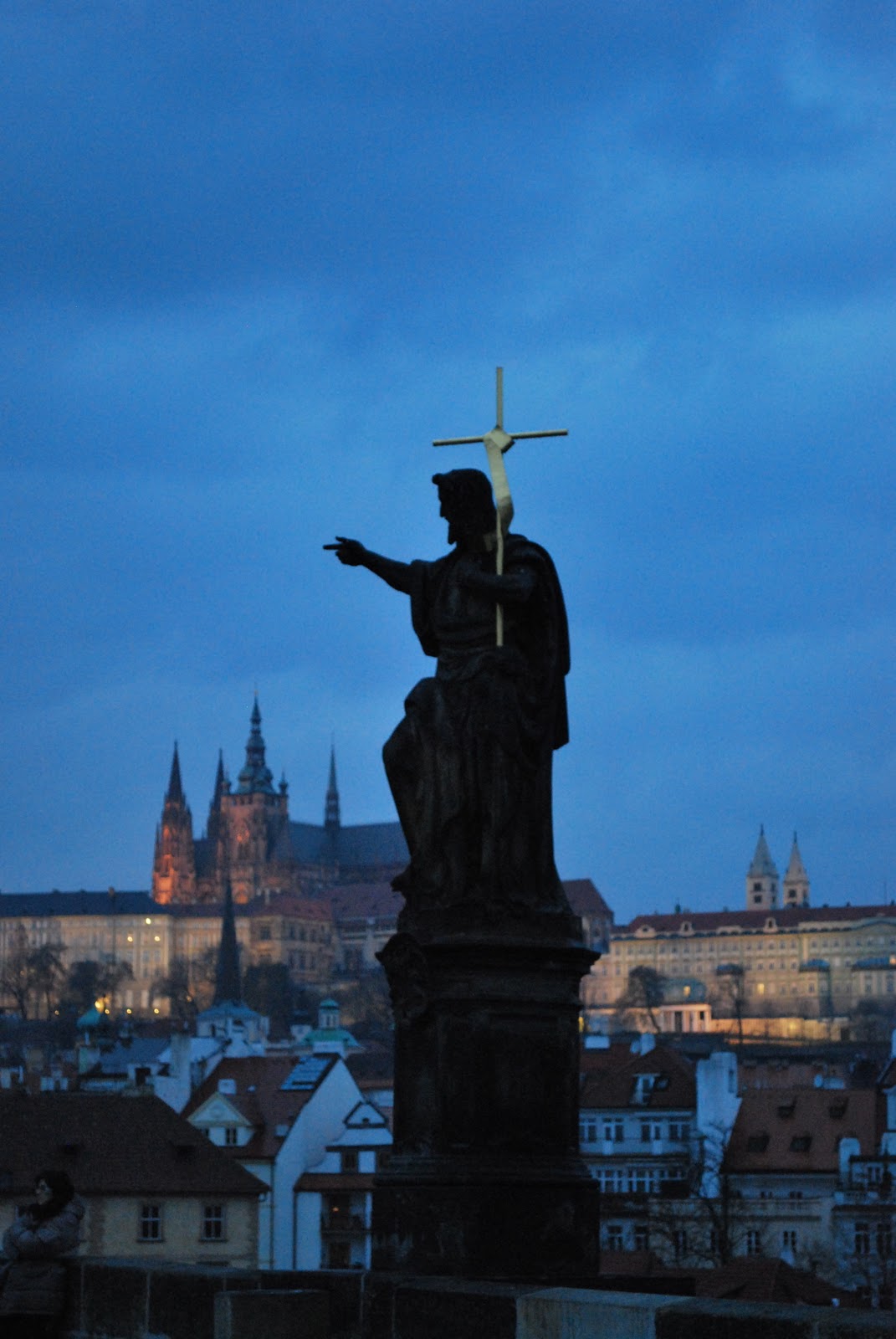
prague castle from the charles bridge

8. something that surprised me about prague was the prevalence of art nouveau.  one of the best known czech artists, alphonse mucha, is an art nouveau artist.  we went to where the old prague castle was and went inside what looked like a gothic cathedral from the outside only to discover the inside had been entirely redecorated in the art nouveau style.  i had never seen an art nouveau church before. it was fascinating.


9. a word about hostels: ours was called the czech inn (get it?) and was actually the nicest hostel i've ever stayed in but we still shared a room with several other people and this can make things interesting. for example when rebecca and i were about to enter our room and man who was not wearing pants opened the door (fortunately he was wearing underwear). he promptly screamed and slammed the door again. we stood there stunned and giggling until he re-emerged (with pants this time) and apologized profusely.

10.  probably my favorite story from the trip: one night as rebecca and i were walking back to the czech inn after a failed mission to find somewhere to get ice cream, two czech police officers came up to us and started speaking to us in rapid czech. when we said we didn't understand, one officer asked to see our passports and explained in broken english: you cross street without sign. what? then i understood. we had just jaywalked and were now being issued a ticket for it. rebecca and i had to avoid eye contact for fear we would burst out laughing a the ridiculousness of the situation.  the police officers explained that because we were tourists we would only get the minimum fine: 100 czech crowns.  this is the equivalent to less than 6 american dollars. it gets better: we decided to stop in a supermarket to get some ice cream and who should we see there but the two police officers who just fined us buying beer with the money they just made off us!!

23.3.11

berlin

last week was spring break, so my friend rebecca and i took a small tour of eastern europe: berlin, prague vienna. in berlin we stayed with my friend gina who's studying there this semester and she was a lovely hostess and tour guide for the weekend.


we saw parts of the wall. 


and we went to the deutschoper to see the premier of a new production of wagner's tristan & isolde.  apparently germans are quite serious about their opera.  we arrived only 2 minutes late but the opera had already started and we were the only late arrivals.  the orchestra and the singers were excellent but i didn't really like the staging. it was a modern reinterpretations with confusing visual metaphors that completely eluded me and which i thought were distracting (at one point a naked man was digging a grave while the title characters sang a duet).  the other audience members were equally unenthusiastic about the staging - they even booed the director when he came out for his bow!


we also went to the history museum which was very interesting. we learned all about the history of germany before world war i. it had lots of fun artifacts including the incredibly gory crucifix above and the contraption below which was supposed to protect one from the plague (way more legit than those surgical masks people wore for bird flu).


we also just wandered around and saw monuments like the brandenburg gate and the reichstag.


i definitely want to go back to berlin someday. there are so many art museums there that we didn't have time for. 

10.3.11

il duomo

begun in 1296, designed by arnolfo di cambio, building continued for 170 years, the famous dome was of course designed by brunelleschi.  apparently when they were brainstorming how to build it, someone suggested that they simply build it over a huge pile of dirt with gold buried inside and then have peasants remove the dirt to find the gold.  they eventually nixed that idea in favor of brunelleschi's ingenious engineering skills and the result remains marvelous to this day.


campanile di giotto: giotto is thought to be the architect of the bell tower.  


19th c. gothic revival façade by emilio de fabis


ghiberti's baptistry doors. 


my host mom said that even though she's been living in florence for 15 years, the duomo has never ceased to amaze her.  needless to say, i'm sure i'll never get tired of it either :)

ps. i went to ash wednesday mass there yesterday. in the u.s. on ash wednesday you usually get a black smudge-y cross on your forehead but here the priest just sort of sprinkled some ashes in my hair. who knew ash wednesday would be different in italy?

1.3.11

manon lescaut

before this year, i had only seen one opera before in my life.  in the last five months, i've seen four.  the most recent was puccini's manon lescaut here in florence at the teatro communale.  i've been a fan of puccini's music for a while but nothing compares to hearing a live orchestra and seeing the performers on stage.  it was absolutely lovely.

the story, based on a french novel, tells of a student, des grieux, who falls in love with manon, a beautiful girl on her way to a convent.  des grieux convices her to run away to paris with him, but she later desserts him because he is poor and takes up with geronte, a rich older man, but she is bored and unhappy with him.  des grieux turns up and the two renew their vows of love to one another, but geronte discovers them and had manon arrested.  manon is sentenced to deportation to louisiana but des grieux manages to convince the ship's captain to let him on.  in the last act, manon and des grieux wander through the dessert trying to make their way to a british settlement but exhausted and weak from thirst, manon dies in her lover's arms.

not only were the orchestra and singers exceptional, but i just fell in love with the libretto.  some of the lyrics are just so poetic that when combined with the overpowering music that they brisent le coeur. i wish i could remember all the italian (thank goodness for supertitles).  there's one moment in act 2 when des grieux reappears and manon begs for his forgiveness and he just looks at her and sings, "o tentatrice!"  it's such a wonderful moment because he knows that she will be his downfall but he takes her back anyway...so tragically beautiful!!


these are some clips of pavarotti singing parts of act i. sooo gooood.  the operas i've seen while abroad have definitely inspired me to see more opera in new york.i can't wait to go to the met when i get back!  i never thought i would get so emotionally invested in the stories but the music is so powerful that it just draws you in. what can i say? i'm hooked.

20.2.11

padova

yesterday i conquered my fears of traveling alone and took myself on a trip to padua (or padova in italiano).  padua is about an hour and a half northeast of florence, near venice. as the train was nearing the station, i glanced at the map in my guidebook for the first time and i realized that neither the train station nor the two sites i wanted to visit were within the range of the map. oh dear. i'll admit i panicked a little. why did i think i could just show up in foreign city by myself and figure things out? but fortunately, i did. it was a beautiful sunny day and there were well-placed signs pointing the way to the major sites so my worries were quickly relieved.  first i went to the church of sant'antonio, dedicated to st. anthony of padua.  st. anthony (1195-1231) was born in portugal but traveled extensively in france and italy as a franciscan preacher before retiring to padua.  he was named a doctor of the church and is the patron of lost things.


there was ugly scaffolding covering the facade but the domes are quite lovely.  you're not allowed to take pictures inside but the interior is beautiful. it's mostly gothic with frescos covering the ceiling and there are also some baroque additions, particularly the chapel of relics behind the alter which is just an explosion of baroque gaudiness.  also of note is st. anthony's tomb which is surrounded by offerings of  photos with prayers written on them.


also in the piazza outside is this statue by donatello which, when it was finished in 1450, was the first equestrian monument since antiquity.

the other site i was dying to see in padova was the scrovegni chapel and its famous frescos by giotto.  this chapel, commonly known as the arena chapel, was commissioned by enrico scrovegni after he read dante's divine comedy which puts scrovegni's father in the seventh circle of hell for the sin of usury--changing interest for lending money--which was apparently frowned upon at the time.  enrico decided to invest some of his family fortune acquired by this grave sin in a magnificent chapel, hoping to save his father (and presumably himself) from the fate described by dante.  the fresco series on the two side walls depict scenes from the life of the Virgin and the life of Christ.  the front wall is covered by a representation of the last judgment.  the chapel was completed around 1305 and caused a revolution in the art world.


it's always super exciting to see the pieces i've studied in real life and this was no exception. reproductions just never manage to capture the visual splendor of the original. it was overwhelming. my favorite things about giotto are his angels and his the gestures of his figures.  especially in the lamentation of christ. the way st. john's hands are thrown back behind him and the anguished poses of the angels in sky make for a very moving scene.  


there was also a pinoteca in the museum next to the chapel that had works by titian, tintoretto, and veronese, among others.  it never ceases to amaze me how many great works of art you can find, even in the smaller italian towns.

on the train ride back at the end of the day, i felt a surge of accomplishment.  i had a really great time seeing things i wanted to see.  i like nothing more than to spend hours in churches and museums but i realize that's not necessarily for everyone.  it was nice to just enjoy the art and not have to worry about whether the people i was with were having fun.  i was glad that i wasn't too scared to take the adventure alone - i felt like such a grown-up!

17.2.11

firenze v. paris: reclining nudes


tiziano, venere di urbino. 1538, galleria delgli uffizi.


manet, olympia. 1863, musée d'orsay.

florence and paris couldn't be more different but the one thing they have in common is that they were both at one point the center of the art world so they still have some of the most famous works of art in the world. titian is one of my favorite italian painters and j'adore manet. one of the reasons i love him so much is the way he includes art historical references in his paintings and adapts them to his era.  both are just so complex that they kind of blow my mind when i think about them.  and both were quite scandaleux in their time.  i couldn't possibly pick a favorite between the two. which do you prefer?

16.2.11

contemporary art in an old palace

so one of the art history classes i'm taking is called art collecting & museology and for our last class we met at the palazzo vecchio for a tour of the former medici residence.  i expected our wonderful british italian professoressa would be leading the tour, but since part of the class is evaluating the ways museums educate the public, we had a museum tour guide who turned out to be an italian man dressed in renaissance garb who told us that when he put on his special necklace we would be transported back to the 16th century. after donning said necklace, he proceeded to introduce himself as giorgio vasari (16th century artist and art historian responsible for the 'modernization' of the palace).  upon learning that we were from "the new world," he called us indians and asked why we weren't wearing feathers (italians aren't big on political correctness, but i'll give him the benefit of the doubt and assume he was adopting the attitudes of the time for authenticity).  i think if i had been on the tour with my family in vacation mode i would have appreciated the time-travel game more, but in with a university group it became rather tedious when he expressed his shock over women who went to school.

the palazzo itself is quite magnificent. i'm becoming a big fan of grotesque decorations on ceilings. the fantastical flora and fauna in rich hues on a yellowed white background are just kind of fabulous.

the other part of the visit which i really loved was the damien hirst exhibit that's currently at the palazzo vecchio. the exhibit is only one piece but i think it's a perfect example of how to combine old and new art.  the piece is called for the love of God and it's a platinum cast of an 18th century skull covered with 8,601 diamonds (in total over 1000 karats).  visually, it's absolutely stunning. even more so because it's displayed in a dark room and light seems to radiate from the sparkly diamonds.


it's actually quite fitting that this piece is on display in the palazzo vecchio because it's displayed in a room right next to francesco i's studiolo. A studiolo or wunderkammer "room of wonders" was a small room used to display objects of all sorts - art, nature, scientific devices, antiquities, and other curiosities.  i think damien hirst's skull would have been right at home in a renaissance studiolo because it's a combination of art and science - a natural object transformed into art.

10.2.11

ravenna

last weekend rebecca and i took a day trip to ravenna. a small town (we actually walked from one end to the other in about 15 min) on italy's eastern coast that was the seat of byzantine rule after it was captured by general belisarius in 540. so it has a few remarkable byzantine churches with lovely mosaics. ever since i studied the byzantine empire in high school, i've really wanted to see these churches in person. the first stop: san vitale.


the colors are even more stunning in person. above, justinian, one of the most important byzantine emperors, is depicted surrounded by generals, including general belisarius, and priests, symbolizing his military/political and religious power.  on the wall opposite is a scene showing justinian's wife theodora and her attendants. theodora is a rather colorful character; she was an actress and a prostitute before converting to christianity and becoming a wool spinner. justinian was not allowed to marry her because government officials were forbidden by law from marrying actresses (aka prostitutes...bad example, ya know), but apparently he was so in love with her that he had the law changed.


as empress she wielded a surprising amount of power for a woman of that time and did much to further women's rights in the byzantine empire.  as a side note, justinian and theodora are the ones who built hagia sophia. i'm just dying to go to istanbul to see it. someday...


ravenna is also home to dante's tomb. although dante is known as the greatest florentine poet, he was exiled from the city so he was not allowed to be buried here. now of course florentines love dante. my host mom was slightly horrified when i told her i'm reading him in english and not the original italian for my divine comedy class.


above, the ceiling of the battistero neoniano from 430. in the center is the baptism of christ by st. john the baptist and the surrounding figures are the apostles. below are photos from sant'apollinare nuovo.


one of the reasons i love byzantine art is i find it charming. the bright colors and rhythmic repetition of forms give the mosaics a playful energy. you can't help but smile :)

fiera di cioccolato

italy just wants to make me fat. not only does my host mom make us pasta for dinner every night, but there's a two-week CHOCOLATE FESTIVAL in santa croce (aka 10 minute walk from my apartment). reasons the chocolate festival is just the best: 


1. the first thing we see when we get there is italian children watching a puppet show. how adorable!!


2.  fondue with dark chocolate and strawberries: yum!

3. it's "freddo" (in the high 30s) here so obvi hot chocolate is necessary.


4.  chocolate is not only delish it's pretty.


5. novelty chocolate items: everything from chocolate saw blades and wrenches to chocolate stilettos. also free chocolate rum shots (not recommended. actually tastes like chocolate syrup mixed with rum.)


needless to say i've eaten way too much chocolate in the last few days. but how could i resist?